Style
Overview
On the "Styles" tab of the "Table Management" screen, you can add styles (CSS) to a table.
What you can do on the Styles tab
- Create, edit, and register CSS using the code editor
- Configure the "Output to" setting for CSS
- Enable or disable CSS
- Use the Code Editor, which helps users edit CSS (available when using the second-generation UI theme)
- Use the draft feature to test how CSS behaves
Pleasanter Code Assist
Installing Pleasanter Code Assist lets you create, edit, and add CSS using the advanced editing features of Visual Studio Code.
Prerequisites
- You need "Manage site" permission to configure this setting.
Operation Procedure
Displaying the Styles tab
- Click "Admin" in the navigation menu.
- Click "Manage table".
- Click the "Styles" tab.
Style list
The "Styles" tab of the "Table Management" screen displays a list of styles.

Selecting a style using the checkbox on the left of the list lets you perform the following operations.
| No | Button | Function |
|---|---|---|
| 1 | Move up | Moves the selected style up one position. |
| 2 | Move down | Moves the selected style down one position. |
| 3 | Copy | Duplicates the selected style. The duplicated style is added to the bottom of the style list. |
| 4 | Delete | Removes the selected style from the list. Clicking "Delete" displays a dialog. Clicking "OK" removes it from the list. |
Creating, editing, and adding a style
- Click "New", or click a style that has already been added to the style list.
- The style edit screen is displayed.
-
Configure each of the following items.
Item Description How to set it Title Enter a title for the style. Enter any title. Style Enter the style. Enter any CSS. Disabled Toggles whether the style is enabled or disabled. Turn this on to disable the style, or off to enable it. Draft Output Mode See Draft Feature. See Draft Feature. Draft Key See Draft Feature. See Draft Feature. Output to Select the screen(s) to output to. See "Setting up Output to" below. What is the Code Editor?
When you are using the second-generation UI theme, you can use the Code Editor, which helps users edit CSS.

The main editing features provided by the Code Editor are as follows.
- Syntax highlighting
- Displaying code hints
- Indenting with the Tab key, and more
To use the Code Editor, set the
EnableCodeEditorparameter inGeneral.jsontotrue.Setting up Output to
By default, the "All" checkbox is turned on in "Output to".

Turning off the "All" checkbox displays the other destinations in "Output to". Select any destination you want.

-
Click "Add" if you created a new style, or "Update" if you edited an existing style.
-
Click "Update" in the command button area.
Disable all
Turning on "All disabled" at the top of the style list disables all existing styles.

Warning
Turning on "All disabled" does not change the state of each style's individual "Disabled" checkbox.
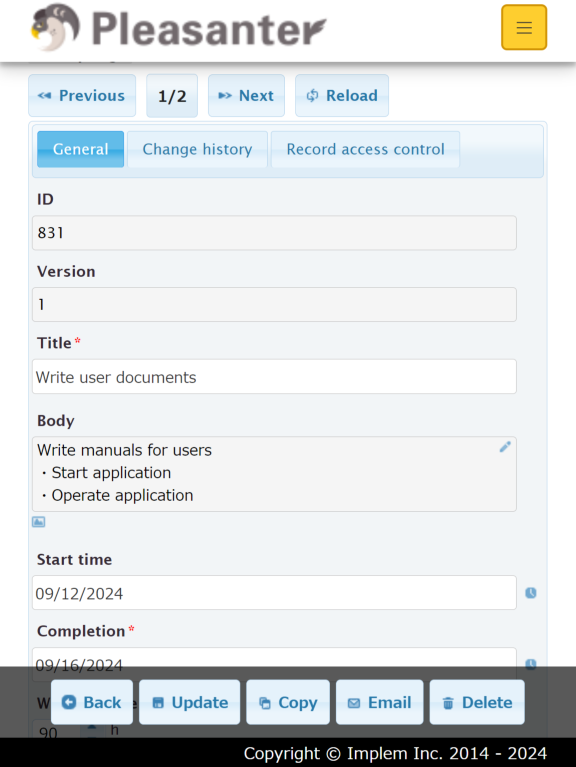
Responsive
When the "Responsive" checkbox is turned on, a style sheet with a responsive design for mobile devices is output.

| Top page | List display screen | Edit screen |
|---|---|---|
 |  |  |
Supported Versions
| Supported Version | Details |
|---|---|
| 1.4.14.0 and later | Added the "All disabled" feature |
| 1.5.7.0 and later | Added the "Draft output" feature |